

瑞士当地时间2026年1月21日下午,第四届达沃斯全球母基金峰会在瑞士达沃斯的Hotel Strela酒店成功举办。本届峰会由全球母基金协会、中国国际科技促进会母基金分会联合主办。作为全球母基金行业久违的一次多边对话,本次峰会邀请了近百位全球母基金、基金以及全球领先的风投城市的重量级人物共聚一堂,共同商议跨越经济周期的奥秘,展望全球母基金和基金行业及风投城市的未来发展新方向。
On the afternoon of January 21, 2026, the fourth Davos Global FOF Summit was successfully held at Hotel Strela in Davos, Switzerland. The summit is hosted by the Global FOF Association. As a long-awaited multilateral dialogue in the global fund of funds industry, this summit invited nearly 100 heavyweights from global fund of funds, funds and the world's leading venture capital cities to gather together to discuss the secrets of crossing economic cycles and look forward to the new direction of future development of global fund of funds, fund industry and venture capital cities.
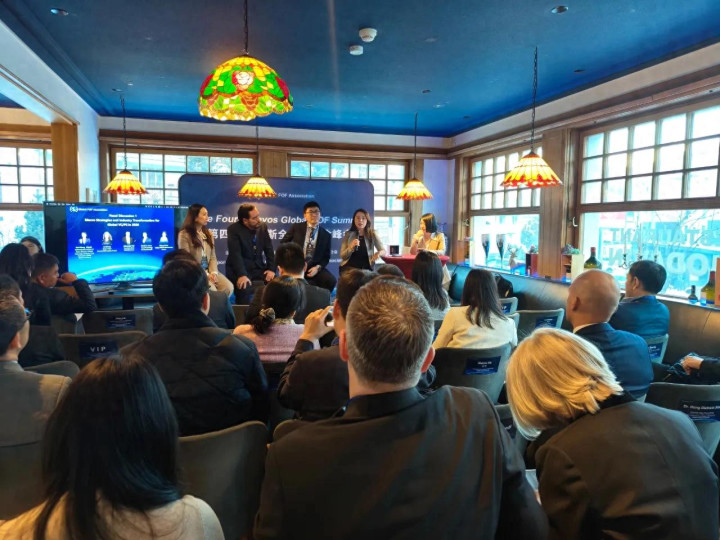
图为以《Macro Strategies and Industry Transformation for Global VC/PE in 2026》为主题的圆桌论坛
第一场论坛以《Macro Strategies and Industry Transformation for Global VC/PE in 2026》为主题,由中央财经大学绿色金融国际研究院院长王遥主持,深度对话嘉宾Fusion Fund创始管理合伙人张璐、The Black Circle CEO/Chairman and investor Alexander Tai、禾赛科技联合创始人兼CEO李一帆、北京颐合中鸿律师事务所合伙人虞梦洁,围绕AI投资的主要趋势与估值泡沫出清情况以及2026年全球经济与投资格局的关键变化与资产配置策略调整等议题展开了深度对话。
The first panel, themed "Macro Strategies and Industry Transformation for Global VC/PE in 2026," was moderated by Yao Wang, Director General of the International Institute of Green Finance at the Central University of Finance and Economics (CUFE). In-depth dialogue guests included Lu Zhang, Founder & Managing Partner of Fusion Fund; Alexander Tai, CEO/Chairman and investor of The Black Circle; David Li, Co-Founder & CEO of Hesai Technology; and Mengjie Yu, Partner of Beijing Alliance J&S Law Firm. They engaged in deep discussions on topics such as the main trends and valuation bubble clearance in AI investment, as well as key changes in the global economic and investment landscape for 2026 and adjustments in asset allocation strategies.
母基金研究中心整理出圆桌发言全文,供行业内人士参考交流:
The speech is compiled as follows:
中央财经大学绿色金融国际研究院院长王遥指出2026 年全球 VC/PE 行业面临技术革新与经济变局的双重影响,本次论坛聚焦两大核心议题:一是 AI 投资的主要趋势与估值泡沫出清情况,二是全球经济与投资格局的关键变化及资产配置策略调整,希望通过嘉宾深度对话为行业提供务实参考。
Yao Wang, Director General of the International Institute of Green Finance at the Central University of Finance and Economics (CUFE), pointed out that the global VC/PE industry will face the dual impact of technological innovation and economic changes in 2026. This forum focuses on two core topics: first, the main trends of AI investment and the liquidation of valuation bubbles; second, the key changes in the global economic and investment pattern and the adjustment of asset allocation strategies. It is hoped that in-depth dialogue among guests will provide practical reference for the industry.
禾赛科技联合创始人兼CEO李一帆指出AI 投资的核心机遇集中在被低估的基础设施领域,百年前美国铁路、互联网初期 AOL 的案例均证明,终极应用落地存在不确定性,但基础设施是全行业共同刚需,具备长期投资价值;需明确区分数字 AI 与物理 AI,前者聚焦思维层面问题解决,后者聚焦物理场景需求,将数字 AI 能力与物理产品结合的领域(如智能机器人、自动驾驶)技术落地难度大但市场空间广阔;资本市场泡沫与技术本身价值需分离看待,2026 年资产配置应聚焦基础设施相关 AI 硬件、物理 AI 落地场景等确定性领域,规避纯概念炒作项目。
David Li, Co-Founder & CEO of Hesai Technology, pointed out that the core opportunities of AI investment are concentrated in the undervalued infrastructure field. Cases such as railways in the United States a hundred years ago and AOL in the early days of the Internet have proven that the landing of ultimate applications is uncertain, but infrastructure is a common rigid demand of the entire industry and has long-term investment value; it is necessary to clearly distinguish between digital AI and physical AI—the former focuses on solving problems at the thinking level, while the latter focuses on physical scenario needs. The field of combining digital AI capabilities with physical products (such as intelligent robots and autonomous driving) has great technical landing difficulties but broad market space; the capital market bubble and the inherent value of technology need to be viewed separately. In 2026, asset allocation should focus on certain fields such as AI hardware related to infrastructure and physical AI landing scenarios, avoiding projects that only rely on concept speculation.
Fusion Fund 创始管理合伙人张璐表示,AI 投资趋势已从 “通用模型竞赛” 转向 “行业落地深耕”,前几年扎堆追逐大模型的资本已更多流向医疗、工业等垂直应用领域,估值泡沫已明显出清;美国市场的显著特征是大企业风险承受力增强,愿意拿出百亿级预算与初创企业合作,接受“5 家合作初创企业中 3 家可能失败” 的创新风险,这种生态为 AI 技术落地提供了良好环境;2026 年全球资产配置应采取 “聚焦高景气赛道+ 分散区域风险” 策略,赛道上聚焦医疗 AI、工业自动化、AI 基础设施,区域上捕捉美、中、欧各自比较优势,早期投资需重视团队的产业资源整合与商业化落地能力。
Lu Zhang, Founder & Managing Partner of Fusion Fund, pointed out that the trend of AI investment has shifted from "general model competition" to "in-depth industrial landing". The capital that flocked to large models a few years ago has now flowed more to vertical application fields such as medical care and industry, and the valuation bubble has obviously cleared; a notable feature of the US market is that large enterprises have stronger risk-bearing capacity, willing to allocate tens of billions of budgets to cooperate with startups and accept the innovation risk that "3 out of 5 cooperating startups may fail". This ecosystem provides a good environment for AI technology landing; global asset allocation in 2026 should adopt the strategy of "focusing on high-prosperity tracks + diversifying regional risks", focusing on healthcare AI, industrial automation and AI infrastructure in terms of tracks, capturing the comparative advantages of the US, China and Europe in terms of regions, and early-stage investment should attach importance to the team's ability to integrate industrial resources and commercialize.
The Black Circle CEO/Chairman and investor Alexander Tai指出2026 年全球经济的关键变化是地缘重构下的供应链分散化与货币多元化,各国为降低依赖正推动区域供应链建设,非美元货币在跨境投资中的作用逐渐提升;AI 估值泡沫出清后,市场更关注技术的实际应用价值与商业化能力,无核心技术、仅靠概念炒作的项目将被市场淘汰;资产配置应采取“核心 - 卫星” 策略,核心资产聚焦高景气赛道龙头企业,卫星资产布局供应链分散化带来的区域机会与新兴技术领域,同时需高度重视地缘风险对投资项目的潜在影响,提前做好风险对冲。
Alexander Tai, CEO/Chairman and Investor of The Black Circle, pointed out that the key changes in the global economy in 2026 are the fragmentation of supply chains and the diversification of currencies under the restructuring of geopolitics. Countries are promoting the construction of regional supply chains to reduce dependence, and the role of non-US dollar currencies in cross-border investment is gradually increasing; after the liquidation of the AI valuation bubble, the market pays more attention to the actual application value and commercialization ability of technology, and projects without core technology and only relying on concept speculation will be eliminated by the market; asset allocation should adopt a "core-satellite" strategy, with core assets focusing on leading enterprises in high-prosperity tracks, satellite assets laying out regional opportunities and emerging technology fields brought by supply chain fragmentation. At the same time, it is necessary to attach great importance to the potential impact of geopolitical risks on investment projects and make risk hedging in advance.
北京颐合中鸿律师事务所合伙人虞梦洁认为,AI 投资与产业转型过程中,合规与监管是不可忽视的关键因素,不同国家和地区对 AI 数据隐私、安全、伦理的监管政策存在显著差异,企业需提前做好合规布局,避免因监管风险影响项目推进;律所作为专业服务机构,核心工作是为企业提供合规与监管领域的最佳实践建议,在投资、并购等商业活动中积极维护企业合法权益;2026 年全球跨境投资将持续增多,企业面临的法律环境更趋复杂,需借助专业法律服务应对跨境交易中的法律风险,保障投资活动顺利推进,尤其在数据跨境流动、知识产权保护等领域需重点合规。
Mengjie Yu, Partner of Beijing Alliance J&S Law Firm, pointed out that in the process of AI investment and industrial transformation, compliance and regulation are key factors that cannot be ignored. Different countries and regions have significant differences in regulatory policies on AI data privacy, security and ethics. Enterprises need to make compliance layouts in advance to avoid project delays due to regulatory risks; as a professional service institution, the core work of law firms is to provide enterprises with best practice suggestions in the field of compliance and regulation, and actively safeguard the legitimate rights and interests of enterprises in commercial activities such as investment and mergers and acquisitions; global cross-border investment will continue to increase in 2026, and enterprises will face a more complex legal environment. It is necessary to rely on professional legal services to cope with legal risks in cross-border transactions and ensure the smooth progress of investment activities, especially focusing on compliance in fields such as cross-border data flow and intellectual property protection.
优配网(官网)提示:文章来自网络,不代表本站观点。